
What is SAP server access?
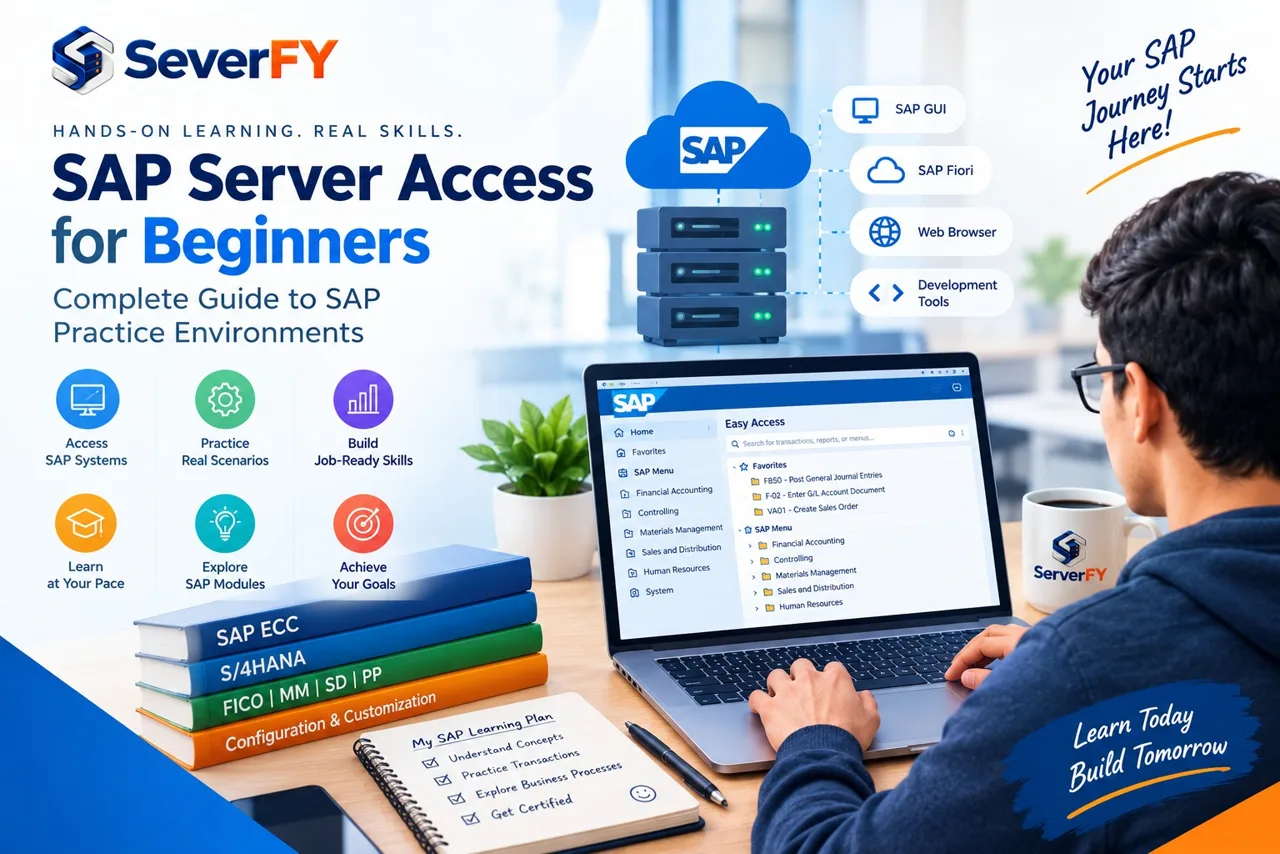
SAP server access is the ability to connect to an SAP system hosted on a server or cloud infrastructure and use that environment for learning, development, testing, configuration, or professional practice. Depending on the environment, users may access SAP through tools such as SAP GUI, SAP Fiori, a web browser, or development tools.
For beginners, the simplest way to understand it is: you receive authorized credentials, connect to an SAP environment, log in, and practice SAP processes and transactions. A practice environment provides a configured SAP system without requiring the learner to build and maintain the complete infrastructure themselves.
Why do you need an SAP practice server?
You can learn SAP theory without server access. However, theory alone does not provide the same experience as actually working inside an SAP system. Reading about a sales order is different from creating one, checking its status, navigating related documents, and understanding how the transaction affects the business process.
Learning teaches you what SAP does. Hands-on practice teaches you how SAP works.
- SAP navigation and business processes
- Transactions and master data
- Configuration concepts
- User roles and authorizations
- Integration between modules
- SAP GUI and Fiori interfaces
- Error handling, testing and real-world workflows
Can you learn SAP without server access?
Yes, you can learn SAP fundamentals — concepts, module basics, business processes, videos, documentation, courses and certification theory — without a practice server. But hands-on access becomes important when you want to develop practical SAP skills.
For example, an SAP FICO learner may study the procure-to-pay process, but practical access allows them to explore the relevant transactions and understand how financial postings move through the system.
Who needs SAP server access?
SAP server access is not limited to experienced consultants. Students use it to go beyond classroom training and prepare for interviews and certification. Beginners and career switchers use it to get comfortable executing transactions instead of only watching demonstrations.
Consultants use practice environments for configuration, testing, new modules, demos and proof-of-concept work. ABAP developers practice programming, reports, enhancements and debugging. BASIS professionals need administration, user management, monitoring and transport concepts. Trainers use a controlled environment for classroom demonstrations and exercises.
- SAP students preparing for interviews and certification
- Beginners and career switchers
- Functional consultants practising configuration and testing
- ABAP developers needing development access
- BASIS and security learners needing administrative access
- Trainers and institutes running batches
What SAP modules can you practice?
The module you need depends on your career path and learning objective. Availability of a particular module or function depends on the SAP environment and the access provided, so always confirm before you subscribe.
- SAP FICO — financial accounting, controlling, financial processes
- SAP MM — procurement, purchasing, inventory management
- SAP SD — sales, orders, delivery, billing
- SAP PP, QM, PM, PS — production, quality, maintenance, projects
- SAP HCM, EWM, WM — HR, extended warehouse and warehouse management
- SAP ABAP, BASIS, Security — development, administration, roles and authorizations
- SAP HANA, BW/4HANA, S/4HANA — database, analytics and modern ERP processes
SAP ECC vs SAP S/4HANA: which should you practice?
SAP ERP Central Component (ECC) is the traditional SAP ERP platform still maintained by many organizations, so learning it stays relevant if your work or training focuses on existing landscapes.
SAP S/4HANA is SAP's modern ERP family built on the SAP HANA in-memory database, with a simplified data model and the SAP Fiori user experience. If your goal is to prepare for modern SAP projects, S/4HANA should generally be part of your roadmap — but the right environment depends on your module, job requirements and course.
- ERP generation: traditional SAP ERP vs modern SAP ERP
- Database: multiple supported databases vs SAP HANA
- User experience: primarily SAP GUI vs SAP GUI and/or Fiori
- Learning focus: existing landscapes vs modern implementations
SAP GUI vs SAP Fiori
SAP GUI is the traditional interface used to access many SAP systems and remains important for professionals working with existing landscapes. SAP Fiori provides a modern, role-based experience, with the Fiori Launchpad acting as the central entry point to applications.
If your career path involves SAP S/4HANA, learning both the relevant SAP GUI transactions and the Fiori apps gives you broader practical exposure. The exact interface available depends on the SAP system you use.
Types of SAP practice environments
Not every SAP practice server works the same way. A shared server is used by multiple learners — affordable and fine for transaction practice, though resources are shared and administrative access may be limited. A dedicated server allocates resources to you, giving more control and customization at a higher cost.
Cloud environments provide remote access without maintaining physical infrastructure. A sandbox is a more open environment intended for experimentation and testing, while a practice system is usually configured around specific courses and exercises.
- Shared practice server — affordable, good for transaction practice
- Dedicated server — control, customization, development and testing
- Cloud practice environment — flexible remote access
- Sandbox — open experimentation and building use cases
What should you check before choosing an SAP practice server?
Choosing an SAP server based only on price can lead to problems later. Confirm the specifics before you subscribe, because a cheap server that lacks your module, your access level or enough resources costs you far more in lost learning time.
- SAP version — ECC, S/4HANA, S/4HANA Cloud or another release
- Required module — confirm the functionality you need is actually available
- Access method — SAP GUI, Fiori, browser, remote desktop or VPN
- Server resources — RAM, CPU, storage, OS, database, connectivity
- User access — number of users, permissions, admin and developer access
- Availability — uptime, maintenance windows, support hours, backups
- Reset options — system, user or database reset, snapshot and restore
- Technical support — how to raise requests, response times, inclusions
- Pricing — setup fees, duration, extra users, renewal and upgrade costs
How to get SAP server access for practice
Getting started is straightforward once you know what you need. Define your learning goal, choose the environment, confirm the technical requirements, receive your credentials and start practising.
Once connected, do not randomly click through SAP. Practice complete business scenarios: Procure-to-Pay (purchase requisition, purchase order, goods receipt, invoice, payment) or Order-to-Cash (sales order, delivery, goods issue, billing, accounting). That is how you understand how transactions connect.
- Step 1 — define your learning goal (FICO, MM, SD, ABAP, BASIS, S/4HANA, Fiori)
- Step 2 — choose the environment: ECC or S/4HANA, shared or dedicated, sandbox or development
- Step 3 — check technical requirements and access method
- Step 4 — get your credentials: host, system details, user ID, password, client
- Step 5 — connect and practice end-to-end business processes
SAP server access for students and consultants
For students, the best environment is not the most powerful server. Focus on the required module, ease of access, availability, learning resources, sufficient resources, support and an affordable access duration. If you are preparing for certification, combine theory with hands-on exercises.
Consultants usually need more: configuration, integration, testing, functional scenarios, troubleshooting, user roles, reporting and end-to-end workflows. Confirm the level of access available before selecting a server.
How much does SAP server access cost?
There is no single SAP server access cost. It varies with the SAP version, server specifications, RAM and CPU, storage, database, number of users, shared or dedicated infrastructure, access duration, support, and customization or development requirements.
Comparing providers only by monthly price can be misleading. Compare what you actually receive for the price.
Common SAP server access mistakes
Beginners often make a few avoidable mistakes. Most of them come from buying first and checking later.
- Choosing only on price — the cheapest server may lack resources or access
- Not checking the SAP version you will actually receive
- Not confirming the module and functionality you need
- Ignoring administrative or development access limitations
- Not asking how technical support works
- Picking a basic transaction server for advanced ABAP, BASIS or HANA work
- Practising without a structured learning plan
Get SAP server access with ServerFY
ServerFY provides SAP server access and infrastructure for learners, consultants, developers, professionals and organizations — SAP practice and training environments, S/4HANA and ECC, FICO, MM, SD, ABAP, BASIS and HANA, plus development, testing and dedicated landscapes.
Tell our team which SAP module you need, which SAP version you want, how many users need access, whether you need shared or dedicated access, and how long you need the environment. We will help identify a suitable environment for your requirements.
Why hands-on SAP practice matters
SAP is a practical enterprise platform. You can memorize transaction codes, watch tutorials and read documentation, but practical experience helps you understand how everything connects — navigation, troubleshooting, business processes, configuration, integration and real SAP workflows.
Learn SAP. Practice SAP. Build real hands-on confidence with ServerFY.
Key takeaways
- SAP server access turns SAP learning from theory into hands-on practice
- Check the SAP version, modules, access method, resources, permissions, availability and support before you buy
- S/4HANA should be part of a modern SAP roadmap; ECC still matters for existing landscapes
- Practice complete business processes, not individual transactions
Questions we get about this
What is SAP server access?
SAP server access allows an authorized user to connect to an SAP system hosted on server or cloud infrastructure and use it for learning, development, testing, configuration, or other permitted activities.
Do beginners need an SAP practice server?
Beginners can start learning SAP without server access, but hands-on access becomes highly valuable when they want to practice transactions, business processes, configuration, or technical activities.
Where can I get an SAP practice server?
You can obtain SAP practice environments through SAP's own learning ecosystem or from providers that offer hosted SAP environments. The appropriate option depends on your SAP version, module, access requirements, and learning objectives.
Can students get SAP server access?
Yes. Students can use suitable SAP practice environments to develop hands-on skills, practice transactions, and prepare for SAP-related interviews or certifications.
Can I practice SAP S/4HANA online?
Yes, depending on the environment. S/4HANA environments can be accessed through supported interfaces such as SAP Fiori and, depending on the edition and scenario, SAP GUI.
Can I practice SAP FICO on a practice server?
Yes, provided the environment includes the required SAP Finance functionality and appropriate user access.
Can I practice SAP MM and SD?
Yes. If the selected SAP environment contains the required functionality, you can practice procurement, inventory, sales, delivery, billing, and related business processes.
What is the difference between an SAP practice server and a sandbox?
A practice system is generally configured around specific learning exercises or scenarios, while a sandbox is a more open environment intended for experimentation, testing, and building use cases.
Should I choose SAP ECC or S/4HANA?
It depends on your career requirements. ECC can still be relevant for existing SAP landscapes, while S/4HANA is important for learning modern SAP ERP environments. If you are starting a new SAP career, understanding S/4HANA should generally be part of your learning roadmap.
What should I check before buying SAP server access?
Check the SAP version, modules, server resources, access method, user permissions, availability, support, pricing, and whether development or administrative access is included.
How long do I need SAP server access?
That depends on your learning objective. A short-term environment may be sufficient for basic training, while consultants, developers, and professionals may need longer access for projects, testing, or advanced practice.
Is SAP server access enough to become an SAP consultant?
No. Server access provides hands-on experience, but becoming an SAP consultant also requires knowledge of business processes, SAP functionality, configuration, implementation methodology, problem-solving, and real-world project experience.